
By Dr. Peter Brookes
The shad run often starts at the beginning of calendar spring, marking the official end of winter and, more importantly, the unofficial beginning of the fishing high season in the Commonwealth.
As Virginia Department of Wildlife Resources (DWR) fisheries biologist, Alan Weaver, put it recently: “Fishing for shad in Virginia is a rite of spring.”
But some may not be aware that shad have a storied history here in Virginia. For instance, it was an important source of sustenance for Native Americans and the first settlers. Though accounts differ, some claim George Washington was a big shad fan, too.
Harvesting Atlantic Coast shad for the table isn’t as popular as it once was, but some still chase these feisty fish for their roe—which some folks swear by as not only tasty, but rich in vitamins.
While both shad species are fun to fish for, hickories and Americans differ in some ways.
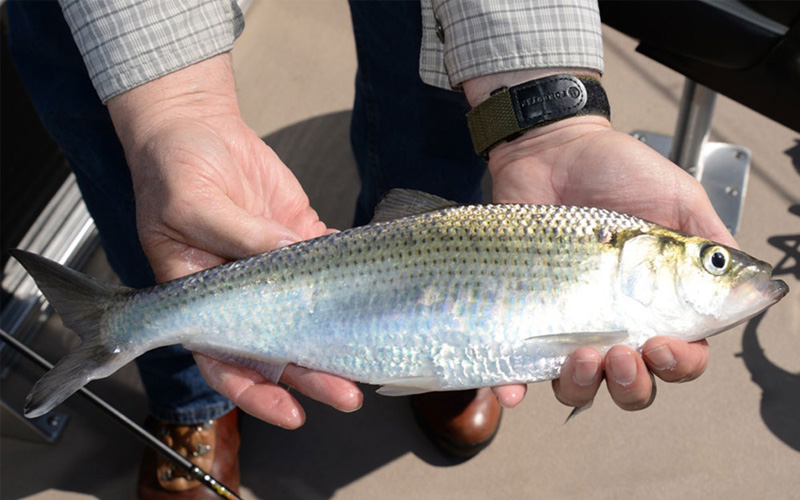
The hickory (or silver) shad is affectionately known as the “poor man’s tarpon.” With its superior (or upturned) mouth and protruding lower jaw, it looks a lot like the famous saltwater fish. Hickories are also known to do aerial acrobatics once hooked—once again like the famous tail-walking tarpon.
The American (or white shad) are identified by a symmetrical (or terminal) mouth with equal upper and lower jaws and have more of a football shape to them. At their biggest, Americans run 20-22 inches, while hickories go a bit smaller at about 15-18 inches, according to DWR.
Two of the top waters for shad in the Commonwealth are the Rappahannock and James Rivers. Angling for this sport fish in these Chesapeake drainages can be done from the shore, while wading, or from watercraft, depending on the location.
But don’t overlook the more-southerly, less-pressured Nottoway and Blackwater Rivers. These Albemarle Sound drainage rivers aren’t wadable and have limited shore fishing, so the shad fishing is best done from watercraft.
In terms of catching shad, both fish will hit the tried-and-true, brightly colored (e.g., pink, chartreuse, yellow and red) shad dart, whether in the form of hard-bodied lure or a fluffy fly. Spoons, jigs and baitfish imitations will also work.
“The hickory is more likely to take a bait near the surface, while the American is best targeted deeper in the water column,” Weaver advised me.
What’s equally terrific is the excitement of Virginia’s irrepressible shad anglers, who are more than ready to welcome these fantastic fish back to the Commonwealth’s rivers every spring.
