
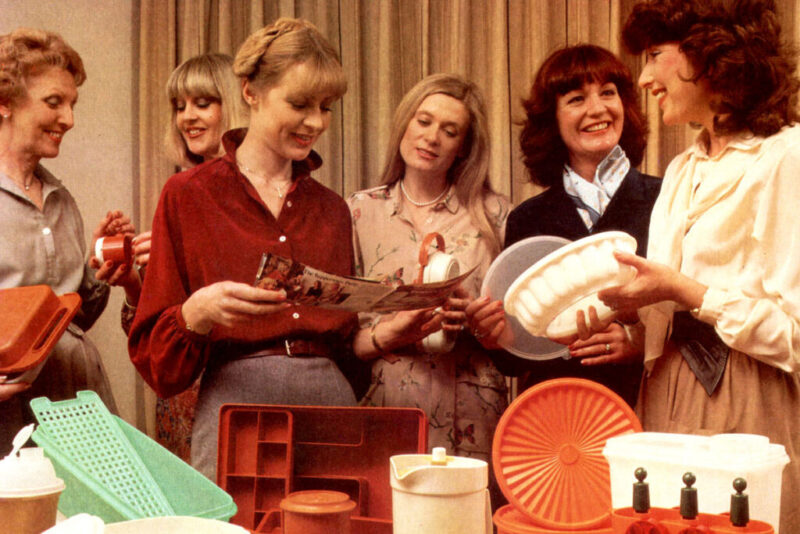
I never went to a Tupperware Party. I was never invited to one, but back during the 50’s, 60’s and 70s, lots and lots of ladies hosted and attended Tupperware Parties.
It all started with a fellow named Earl Tupper who invented an airtight plastic container made from recycled polyethylene from wartime manufacturing. At that time, kitchen leftovers were most often store in waxed paper, which was hardly airtight, or sometimes in glass containers. Tupperware was a truly innovative product, but it at first, it didn’t sell.
Customers were confused because they really didn’t understand the concept of the “burping” sound when the lid was sealed and many thought the lids were too tight, didn’t fit and they returned the products.
Then along came a brilliant saleswoman named Brownie Wise who understood that home demonstrations would be the most effective way to market Tupperware. Instead of sitting on store shelves, the containers were brought directly into people’s homes, where customers could watch demonstrations, ask questions, and handle the products themselves.
And they had fun at the Tupperware Parties. At that time, many women were stay-at-home housewives, and they welcomed the prospect of a little socializing, having some cake with friends and getting out of the house. Hostesses were given incentives such as free products based on sales, which encouraged them to invite more guests. Independent consultants earned extra income by hosting parties and building networks. Plus, once the consumers understood the magic of Tupperware, it was a game changer.
Tupperware Home Parties quickly developed into a nationwide sales network.
By 1954, roughly 20,000 people were involved in Tupperware’s sales system as dealers, distributors, and managers, all supporting its rapidly growing direct-sales operation. That same year, Tupperware sales reached $25 million — equivalent to roughly $310 million in 2026 dollars.
Then things began to change. More ladies entered the work force and had less time and inclination for weeknight parties. And the big box stores got in on the act. When the Tupperware patent expired in 1984, it was all over but the shouting. Big box stores sold their versions of plastic storage containers, and the Tupperware Parties soon became history,
Tupperware declared bankruptcy in 2024, but it was quite a run. Even today “Tupperware” is a widely used term for plastic containers that burp.
I don’t know about you, but our cabinets and shelves are loaded with Tupperware, and it’s been a long time since he last party.
